My incorporation of witchiness into my earthbound day-to-day life began with the heavens. When I read The Discovery of Middle Earth: Mapping the Lost World of the Celts by Graham Robb (Norton, 2013), I learned for the first time the meaning of words like “solstice” (the Celts believed the sun remained stationary for several days at the solstices) and “equinox” (you can see this for yourself: at the equinoxes, the sun rises and sets in the exact middle of the horizon). We’re always told these things are happening, usually by the person giving us updates on the weather, but nobody ever tells us what they mean.
I’d always liked the moon, but once I started regularly paying attention, it began to feel like we had a relationship. I began to see her (the moon’s pronouns are she/it) as a manifestation of the goddess, I suppose in a way similar to the ancient Egyptians thinking the sun was a god. I began to want to understand her, to pay attention to her phases. I learned that the moon is “waxing gibbous” when the right side is illuminated viewed from the Northern Hemisphere. A waning gibbous moon is illuminated on the opposite side. You can tell if a crescent moon is waxing or waning too. If it’s waxing, the points of the crescent face left. In the days before TV, social media, and Christianity, these simple forms of knowledge were intensely meaningful to people, as was the fact that during its dark phase, the moon is actually new and getting ready to reappear.
I feel kinda weird saying this, but you can talk to the moon. And it’s a lot easier than talking to the sun, because looking at it won’t blind you. There’s a metaphor in there somewhere, and I’ll parse it out when I’m feeling less embarrassed.
Behind my house are a number of black walnut trees. When my niece visited over Christmas, she said my yard has the fattest squirrels she’d ever seen. I explained that’s because the black walnuts are a habitat, a squirrel sanctuary, a reliable food source, as long as nobody in the Homeowners’ Association gets a notion to cut them down. If they do, I’ll fight for those trees and my fat squirrels.
I wish I could get to know the squirrels better, but they’re probably still mad at me for putting Flaming Squirrel hot pepper oil on the bird seed in the feeder. But when squirrels are making a feast out of the bird food – which they will if it’s not treated – they’re less easy to love. Though one year we had a pure white squirrel out there, until it got run over by a car. All the neighbors loved that squirrel.
The birds are ordinary backyard birds, cardinals, sparrows, juncos, orioles, blackbirds of variously hued wingtips, mourning doves, a solo blue jay with an aggressive personality, a black-and-white striped woodpecker with a red crown. The odd crow caws to its fellows. On occasion, a Cooper’s hawk will appear in the crabapple tree, scaring away the other birds. And at night, I can hear the hooting of a great Great Northern owl and sometimes its mate. I know it’s a Great Northern because one cloudy night I went out with my binoculars and walked around the neighborhood until I saw this animal about the size of a large house cat perched in the branches of a tall tree. I could see its tufts through my binoculars. I think it knew I was watching; I felt it looking back at me.
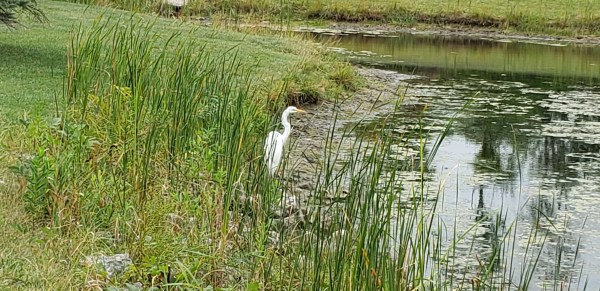
A wild turkey hen comes by every summer with her big chicks. Sometimes we even see the magnificent waddling beast of the male turkey. A mated pair of mallard ducks swims in the canal behind the house. Sandhill cranes in a small flock tour the neighborhood in summer with long-legged grace, and in the pond across the street, I’ve seen blue heron and a snowy egret.
And once there was even a pair of peacocks racing through the yard like escaped convicts. They were escapees, from a nearby peacock farm.
This is nature, as it manifests in a suburban backyard in the twenty-first century, vulnerable, as more and more habitat is destroyed, in constant need of protection by and from humans, and bringing with it something magical whenever it appears.
Blixi Federberg
 Witchiness